Wednesday, 11 September 2013

HOW THINGS CHANGE


Having recently bought my daughter a Kindle e-reader for her birthday, I was thinking how things have changed.

I can remember, as a child, being really excited when I got a book for my birthday, particularly if it was one I had been waiting to read. E Nesbit was one of my favourite authors when I was younger. The Railway Children and Five Children and It being two of my favourites. I moved on to Jane Austin, and eventually Nora Roberts, all romances and all proper books. Although most of the classics got sampled at some point in time, I hated Dickens, loved Shakespeare and gave up if a book made me cry, like Black Beauty.

I still like paper books, but my little Kindle is so much easier to take on holiday, or slip in my bag to read on the train, and my granddaughter can read a full-length novel on her phone.

I write romantic suspense, and I like writing full-length novels, but it is getting harder and harder to get a 90,000 word book accepted by a publisher unless, of course, you are a big name already. My novellas, the ones already published by D.C.Thomson, are all on Amazon, but I’m rubbish at publicising myself, so they don’t sell as well as I would like – and I don’t write all that fast so I can’t produce four or five books a year, even novellas. So what do I do next?

I have a horrible feeling that by the time I decide what to do next, everything will have changed again.

Wednesday, 4 September 2013

Choosing A Project

Is it only me, or does anyone else start to panic when there is yet another Email about a new E-Publisher starting up and wanting your stories, right here, right now!
     I know I should be very glad that there are so many opportunities to get published these days but the fact is that I can't write quickly enough to take advantage of them all. Then I find I can't concentrate on one project alone because I keep thinking of other plots just ideal for that new publisher.
     I now have several manuscripts in various stages and targeted at different publishers from my writing this year, and all of them are un-finished.
In the end, I went back to my comfort zone and wrote a new Pocket Novel over the summer which I've just finished and am about to submit.
     But now that it is done, I have to decide what to do.
     I hope I'm going to be brave and take that next step and try something a bit different, if only because it should make my writing fresher and better.
Do you have a drawer full of half-finished stories? Are they worth reworking or is it better to start something entirely new? I'd love to know your thoughts.

Wednesday, 28 August 2013

Love and Death - Dealing with Big Themes in Light Romance


As a writer of romantic intrigue, my work includes two very big themes; love and death. The love is, of course, the romance. The death, usually a murder, is very often the catalyst that brings the hero and heroine together. There may also be the fear of death, as there is in my book Midnight Train, where a group of people are stuck on a runaway train bearing a nuclear device. Having a hero and heroine have to cling on to each other during a shoot out is a great way of bringing them together!
 

The main problem is how to deal with death in what is essentially a light romance.  The death, like any conflict, has to have some bearing on the overall story. However, it cannot be so close to the hero or heroine that it would be unrealistic for them not to grieve for a while. In one of my stories (unpublished) I wanted to kill off the heroine’s father partway through the story, but it occurred to me that if I did that, it would change the tone of the story completely. She would be too busy grieving for her father to fall in love, and if I rushed it, and had her suddenly get over her father’s death within days, then she would not be the heroine I had envisaged. For that reason, if heroines in my other stories have dead parents, I make their deaths happen sometime in the shadowy past. That way she can still be sorry she’s lost them, but she’s over the worst of the grief.
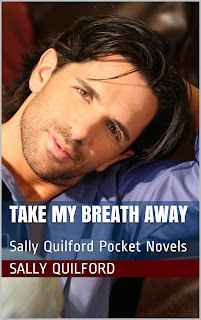
 

Writing a murder into a love story is usually a bit easier, as it’s often a person that no one much likes, but who is connected to the hero and/or heroine in some way that puts doubts on their relationship. Or they disagree over the best way to deal with the murder. Or the murder just brings them together to investigate; anything that ties the death/conflict to the story. I bucked this trend in Take MyBreath Away by having the first murder victim as the rather likeable, but hell-raising, ex-husband of my heroine, Patty Carter (I’m not giving anything away here, it’s all in the first chapter!). However, whilst Patty mourned his death, they had been split up long enough for her not to grieve in the same way as if they’d had a long and happy marriage. So she is able to move on and connect with the new hero in her life. The conflict comes from the hero thinking that she’s the killer and what he’s going to do about it if that turns out to be true. The important thing is that the reader is not dragged down by the characters’ misery and grief.

There is a place for a more thoughtful and deep exploration of love and death, but do remember we’re writing light romance here (or if you’re not already writing it, you’re reading this blog because you may want to).

You could get over the issue of grieving over a death that happens in the course of the story by having a time lapse of several weeks or months. On the other hand, you don’t want them dealing with the loss of a close loved one by recovering within days or in a time that seems too short to be realistic to the reader.

A participant in one of my workshops had a scenario where the hero’s wife had died just six months before he met the heroine. Now I know that in real life people no longer wait a ‘respectable’ year before becoming romantically involved with others, or even in getting married again (my step-father moved his new girlfriend in on the night of my mother’s funeral!) but in fiction, unless the hero’s wife was a real bitch, it would seem callous that he suddenly found himself in love with another woman so soon after losing his wife. Six months, for most people, is not enough to come to terms with the loss of someone you loved dearly. I suggested to the writer that she makes it at least a year, and possibly more since the first wife died, just to put that little bit more distance between the death and the new romance. The hero could still have the same doubts, and fear that he’s being unfaithful to the memory of his first wife, but it tones down the angst a few notches so that the reader doesn’t feel as though they’re drowning in tears.

One of my favourite books by Kate Walker examines the feelings of a widower finding a new woman to love after the death of his wife, but it’s been a while since the wife died, so the story isn’t bogged down by his grief, even if he does have lots of feelings of guilt. What I particularly liked was that Kate didn’t feel the need to demonise the wife to make the heroine seem more important in the hero’s life.

So you can write about love and death, but if you want to write light fiction, you need to use a lighter touch; one that doesn’t undermine the sadness of death, but which also doesn’t make the reader feel like slitting their wrists after five pages of the heroine lying on her bed thinking about what a vale of tears her life has turned out to be.


Friday, 23 August 2013

Thanks to the Romaniacs for an invite to their blog

That super group of writers, the Romaniacs who love all things romance invited me on their blog this week for their Tuesday chit-chat. Do go over and say 'hello' if you have any comments as it's always lovely to chat to people about writing. As my serial, The Lemon Grove is still running in the People's Friend magazine, they asked me about my route to publication in serial writing. This week is part 6 of 8, where 'the other man' appears. This is a device I've used often in my stories as I think it adds a perfect element of internal conflict. Internal conflict is a difficult thing for us as writers to tackle. It's easy to think up an external goal and it's always better if you can make that external goal clear and plain even so far as making it something you can see. Examples of external goals might be finding the treasure, killing the enemy or escaping from the baddy. However it's the internal conflict which really grabs a reader. For my heroine in the serial, her external goal could be summed up thus: girl takes up overseeing redecoration of a beach house for her brother in order to put her life together after broken engagement. That's simple. The internal conflict though is less simple to define but often in a romance is so central it must not be ignored because it is in tackling internal conflicts that people change. With my heroine Caroline she's still in two minds about whether in leaving her fiance, she did the right thing. Her internal conflict is to decide whether the things she saw in her old lover Peter are the things she really needs emotionally or whether she should risk allowing herself to fall in love with a new man, Antonio. We all have internal conflicts, sometimes we don't even admit them to ourselves. But the two journeys the main protagonist of your story makes, the external goal that can be seen and easily identified and the internal goal which cannot be seen but which forms the main change in character provides the main conflict and is therefore essential in keeping your reader turning the pages.


Sunday, 18 August 2013

Free Dowload

Hi All,
My book, 'Relative Strangers' is free to download on Tuesday (20th) from 9am

>>At 15, Jemima is pregnant, scared and her baby is to be adopted. Many years later, when her daughter is having problems with her boyfriend, she decided to go and look for her son.<<
http://www.amazon.co.uk/Relative-Strangers-ebook/dp/B00E3SGKTK/ref=sr_1_1?s=digital-text&ie=UTF8&qid=1374654007&sr=1-1&keywords=relative+strangers+endeavour

Hope you enjoy it!
Love Chrissie x

Wednesday, 14 August 2013

With so much recent activity regarding the pocket novels and the social networking, I fear the business of actually writing may have lapsed somewhat. I always feel every now and then it's a good idea to get back to basics. By that I mean plot construction. It is true of any form of writing, not just pocket novels but short stories, long short stories (over 3000 words) and longer novels. Even if you only have the barest glimmer of an idea get it down on paper, then play around with it. It's amazing what your sub conscious can come up with. Spend an hour or so doing nothing else then sit back and read what you have written. You will be pleasantly surprised. it's what I was taught to do in the early days and it always works for me.

Wednesday, 7 August 2013

How do you plot?

I have just started to write something new after a gap of more than a year. I have not been away from writing, just putting up my blacklist on to Smashwords and Kindle. At the moment I am editing "A Chance Encounter" which will be the 12th Regency romantic adventure to be published on KDP. At the same time I am attempting to add 1000 words a day to my new book which is entitled "The Duke's Proposal". What has this to do with plotting? Well – I am writing this new book without any planning at all – the original story came to me when I was half asleep and I was so pleased to have something to put down on the blank screen, that I went with it. I dictated 2000 words, while doing so the main characters came alive in my head, as did the setting. However, I then had to go back and write the opening chapters and when I got to the scene I had written I realised neither character would have behaved like this and so the entire thing was scrapped. I didn't mind as writing this had got me going again. If I had plotted story before I started I would have avoided wasting 2000 words. I don't write my Regency books with any more planning than an idea and voices of the two main characters in my head. I then let the story develop, characters go where they want, and it works for me. With my mainstream historical novels, "Barbara's War and Hannah's War", I worked quite differently. I needed to do a timeline, far more research, and have a page of notes for the plot. Not as detailed as an outline, more a guide. Jean Fullerton plots her books scene by scene, she puts everything on a virtual A3 sheet, before she starts. She notes down significant historical events, whose point of view she will be using for that scene, and a couple of lines on what will actually happen. Therefore when she starts writing the book she knows exactly where she's going, can tick off a scene as it's done, and check the historical accuracy. It works by her – she is a well-known and respected writer of historical fiction. "Call Nurse Millie", her latest book is already proving to be a big hit with readers. Maureen Lee,a bestselling historical saga writer, does no written planning but works the whole story out in her head before she starts. She does her research whilst she is writing, not before she starts. How do you do it? It's always fascinating to get inside a writer's mind – I would be interested to hear what other writers do. Fenella J Miller